The Review
Pedigree Dentastix Fresh Review: Does a Daily Chew Actually Reduce Tartar in a Large Dog?
Thirty-six mint-flavoured X-shaped sticks, one a day, sold on a clinically proven plaque and tartar claim. We tested that claim against what dental chews can and cannot do for a large dog's mouth.
By Dr Elise Murphy, BVSc (Hons)
24 August 2026
9 min read
Medically reviewed
Reviewed by Dr Noor Haddad, DVM, DACVD of the Dr Murphies Veterinary Review Board. Reviewed content is checked against current consensus guidance before publication.
Periodontal disease is the most common diagnosis we make in dogs, and by a wide margin. By the age of three, the majority of dogs already have measurable gingival inflammation, and a large dog with an untreated mouth will lose bone around the carnassials long before an owner notices anything worse than bad breath. So a daily dental chew is not a frivolous purchase. The question is only whether this particular one earns its place, and its calories.
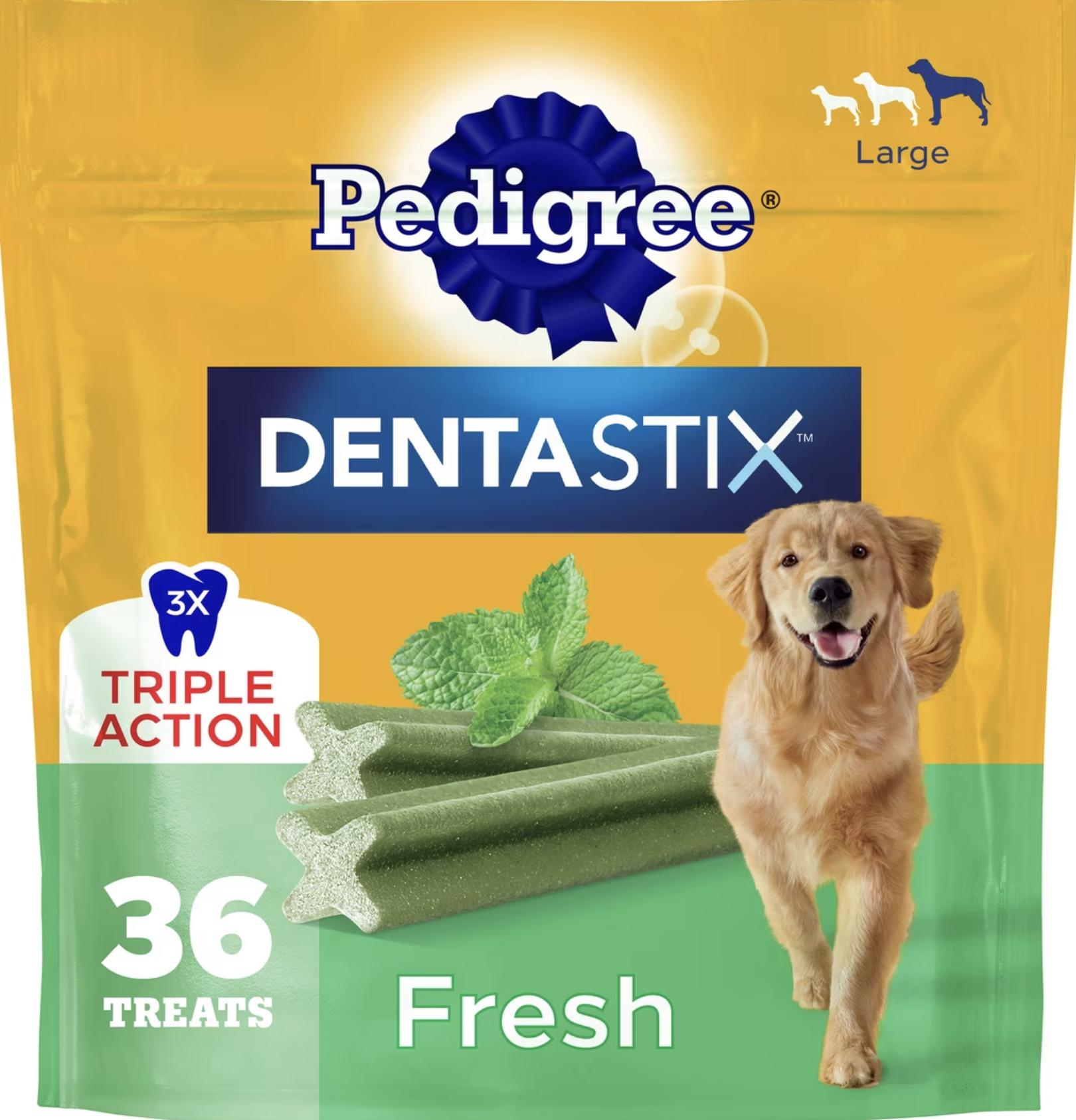
Pedigree Dentastix Fresh, in the large-dog size, comes 36 sticks to a bag: one chew per day, roughly five weeks of use. The sticks are green, mint-flavoured, and extruded into an X-shaped cross-section that the packaging makes the centrepiece of its argument.
What the shape is actually doing
The X-profile is not marketing invention. Mechanical plaque removal from a chew depends on the tooth surface staying in contact with an abrasive, slightly yielding material for long enough to disrupt the biofilm. A round or flat stick tends to be crushed and swallowed; a ridged, multi-armed profile forces the crown to sink into the material and drag along it, which extends contact time and reaches a little further toward the gingival margin than a plain biscuit does.
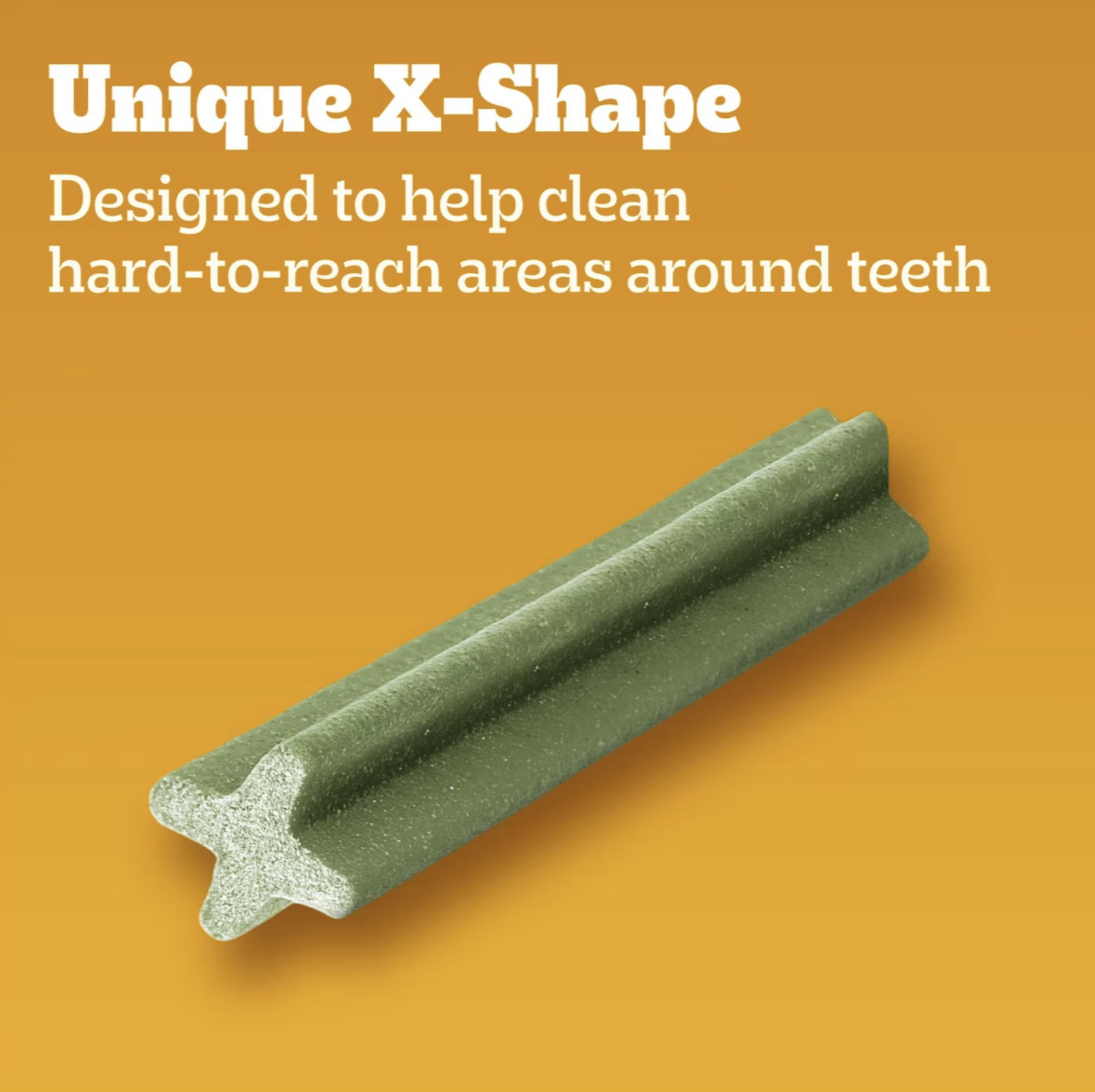
Where we would temper expectations: chews work on the buccal surfaces of the premolars and molars, which is where most visible tartar sits, and they do very little for the incisors, the canine tips, or the palatal and lingual surfaces. A dog that swallows the stick in three bites gets almost nothing from it. Chewing duration is the active ingredient here, not the flavour.
Reading the clinical claim honestly
The bag says clinically proven to reduce plaque and tartar buildup. That phrasing has a specific meaning in this category. Studies on daily dental chews of this type consistently show meaningful reductions in calculus accumulation and, to a lesser degree, plaque, compared with feeding dry food alone. The effect is real and repeatable. It is also partial: reductions are measured in percentages, not in the elimination of disease, and they depend on daily use rather than occasional use.
The honest framing is that a daily chew slows the rate at which a mouth deteriorates between professional cleanings. It does not replace scaling under anaesthesia, and it is a distant second to toothbrushing, which remains the only home measure that reaches every surface. If you want a hierarchy: brush daily if you can, chew daily if you cannot, and do both if the dog will tolerate it.
The composition
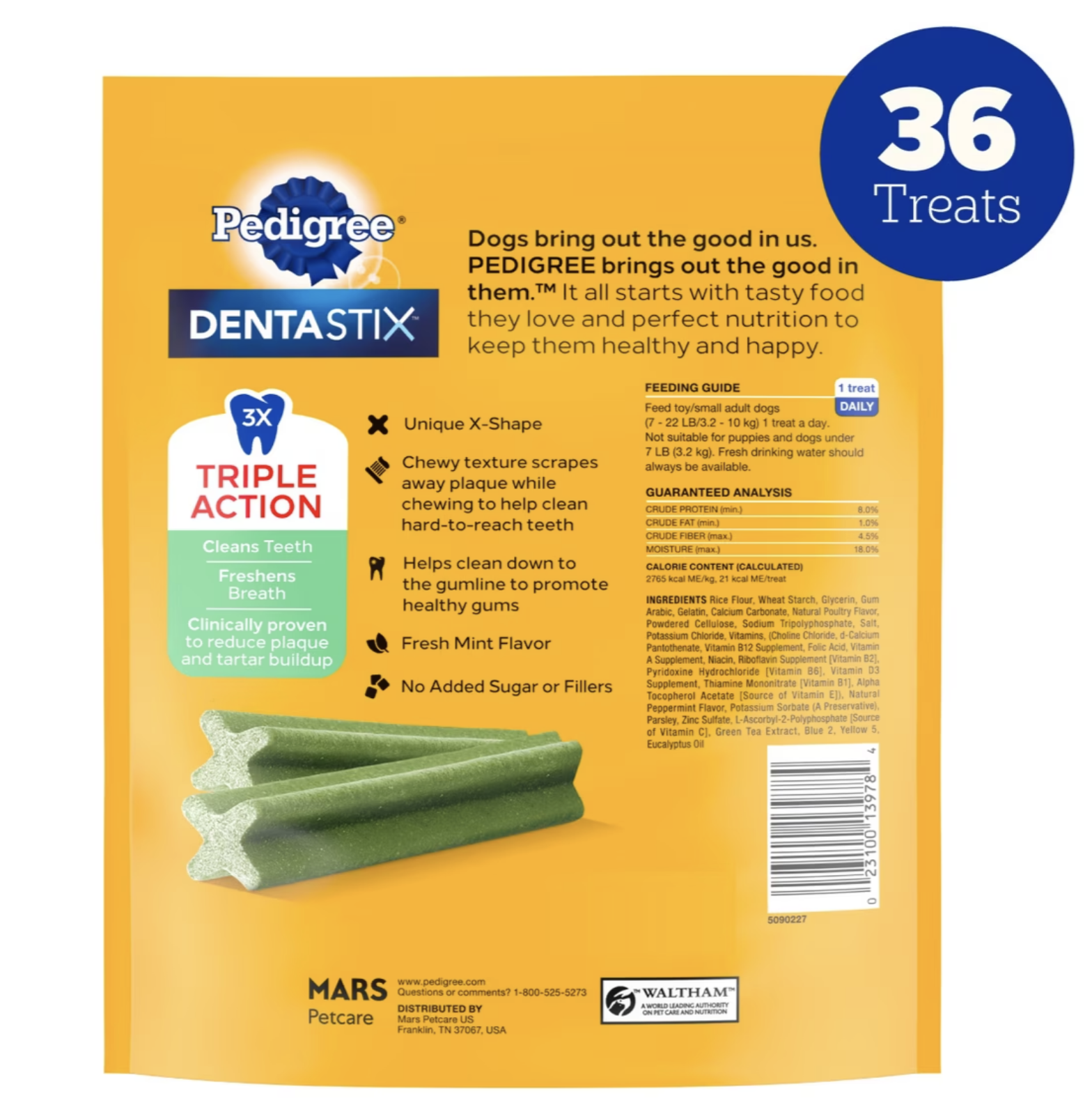
This is a starch-based chew, not a meat product. Rice flour and wheat starch lead the panel, bound with glycerin, gum arabic and gelatin, with calcium carbonate, sodium tripolyphosphate, powdered cellulose and natural poultry flavour following. Sodium tripolyphosphate is the functional inclusion worth naming: it binds salivary calcium and is the reason a chew of this type suppresses calculus formation rather than merely abrading it away.
- Guaranteed analysis: 8% minimum crude protein, 1% minimum crude fat, 4.5% maximum fibre, 18% maximum moisture.
- 2,765 kcal ME/kg; the pack states 21 kcal per treat for the size shown on its panel.
- Starch matrix: rice flour and wheat starch, with gelatin and gum arabic as binders.
- Sodium tripolyphosphate included as a calculus-control agent.
- Natural peppermint flavour, parsley, green tea extract and eucalyptus oil for breath.
- Contains Blue 2 and Yellow 5 colouring; no added sugar per the pack.
Nutritionally this is close to inert, which for a daily treat is a point in its favour: very low fat, modest calories, nothing that will unbalance a complete diet. Treats should stay under roughly ten per cent of daily calories, and one stick sits comfortably inside that budget for a large dog. Deduct it from the bowl anyway.
The breath question
Peppermint, parsley, eucalyptus oil and green tea extract will freshen breath for a period after the chew. That is a cosmetic effect and should be read as one. Persistent halitosis in a dog is a clinical sign, most often of periodontal infection, sometimes of gastrointestinal, renal or oral-mass disease. If breath odour returns within the hour, or the gums bleed on contact, the chew is masking something that needs an examination.
Safety and who should skip it
Starch-based chews soften and break down predictably in the stomach, which makes obstruction far less likely than with rawhide knots. The residual risks are the ordinary ones: a fast eater bolting a whole stick, and choking on a final short segment. Supervise, and take the last inch off an enthusiastic gulper. The pack specifies the treat is not suitable for puppies or dogs under the stated minimum weight, and the size band matters: give a large dog the large stick, not two small ones.
- Not for puppies, or dogs below the pack's stated minimum weight.
- Wheat and rice based, so unsuitable for elimination diets and confirmed grain sensitivity.
- Contains artificial colouring; approved at these levels, but not to every owner's preference.
- Not a dental treatment for an already diseased mouth, which needs scaling under anaesthesia.
- Low value for a dog that swallows rather than chews.
Who it suits
A healthy large adult dog with a reasonably clean mouth, an owner who will not realistically brush every day, and a household that wants to slow tartar accumulation between annual dentals. Used daily and counted into the calorie budget, this is a sensible, low-fat, low-risk piece of preventive care at a modest cost per day, and dogs take to it readily.
It is not the product for a dog that already has visible calculus, receded gums or a fractured tooth. That mouth needs charting, radiographs and scaling first, and a chew afterwards to hold the ground you gained. Nor is it right for a grain-sensitive dog, a puppy, or a dog on a strict elimination trial.
Our read: a well-designed, honestly claimed daily chew that does a real but partial job. Judge it as maintenance between cleanings, not as a substitute for them.
Vet-recommended
Products our review board rates for this

Lemonade Pet Insurance
9.4The lowest premiums in the category, with claims paid in minutes rather than weeks.
Dial A Vet
9.0A global team of 250+ vets and vet techs on Zoom in under fifteen minutes, flat fee.
Spot & Tango
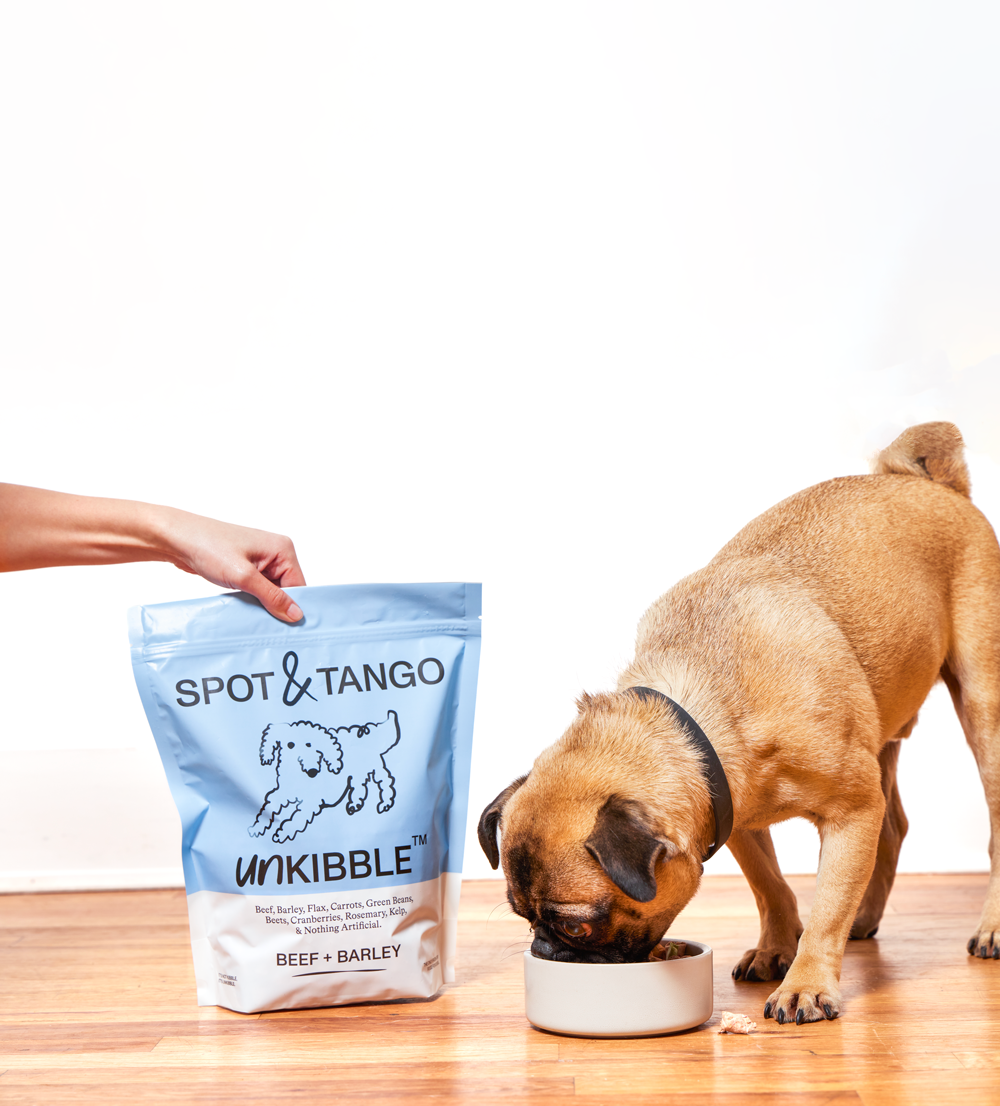
9.1Vet-formulated fresh trays and dehydrated UnKibble, portioned to the individual dog.
Recommendations are chosen by the Dr Murphies veterinary review board. Some links are affiliate links and we may earn a commission; this never affects our scoring, and brands do not see our copy before publication.
Dr Elise Murphy, BVSc (Hons)
Editor-in-chief